Milestones

Milestones don’t mean anything. A marker noting the 12th mile down a road is no more significant than the marker for the 17th mile. Unless of course you are the one walking down the road.

This past week I saw two milestones. The first has to do with running. I passed my previous highest total number of running minutes for a year. Which makes it the most I’ve run in over 10 years. And we are still in October!

This morning I also finished reading my 75th book of 2012, thus meeting the 75 Books Challenge of the group I participate in over on LibraryThing. So far it has been a good year for reading, and I’m glad I filled out the set with Alice Munro’s latest collection of stories. But I’m more pleased with the fact that I have written a short review for every one of the books I’ve read this year. That has been a lot of fun and it is something I intend to continue with in the future.

The other thing about milestones, when you see them along a road you are walking down, is that you just keep on walking.

Dear Life: Stories by Alice Munro


Almost any story you choose to read by Alice Munro will better than almost any other story you might have read, even those by Alice Munro. There is something lulling in the cadence of her sentences, her observational choices, her sudden turns that are not turns at all. Something that makes you think, as you read one of her stories, that this is it, this is what real life, a certain life at least lived in a certain place and time is like. Honesty might be a word for it, if fiction can be honest. I hear the voice of my mother, or an aunt, or one of my grandmothers in these stories and I think, even if I disagree with what they are saying, that’s the way they see it.

Of the stories in this collection, I would single out “Amundsen” for its clash of naïveté and self-serving motives, “Haven” for the unflattering portrayal of familial relations, and “Train” for the way it treats a life as iterations in a quest for solidity and peace. But I might just as easily have chosen any of the other stories.

The final four pieces in the collection are grouped together under the title “Finale”. These are, Munro says, “autobiographical in feeling, though not, sometimes, entirely so in fact.” In them, Munro looks at a few incidents of her childhood that cast her, momentarily, in an unfavourable light. They are, some of them, shameful thoughts or actions that she may be excising. In “Night”, her father reassures her. “People have those kinds of thoughts sometimes.” And it is precisely what she needs to hear in order to overcome her anxiety driven insomnia. Other regrets, such as not attending her mother’s final illness, death, and funeral are not assuaged by the calm comfort of a wise father. “We say of some things that they can’t be forgiven, or that we will never forgive ourselves. But we do—we do it all the time.”

Highly recommended.

Wild Writers in Waterloo

On November 2nd and 3rd, Waterloo will cut loose with the Wild Writers Literary Festival. Presented by The New Quarterly, in association with Words Worth Books, hosted at the Balsillie School of International Affairs, with loads of worthy local sponsors, the WWLF consists of a number of talks, workshops, panels, and performances. It’s a mixture of paid and free events, and with three parallel sessions throughout the day on the 3rd, there ought to be something for anyone interested in reading and writing.

There are so many excellent writers participating that it would be hard to pick even one or two I am most keen on hearing, but perhaps Michael Crummey, Alexander MacLeod and Andrew Hood stand out, unless they were pipped at the post by Elizabeth Hay, Alison Pick, and Carrie Snyder.

I hope that WWLF is a huge success and returns yearly.

Note: you need to sign up in order to attend even the free events, so do be sure to register.

In the north

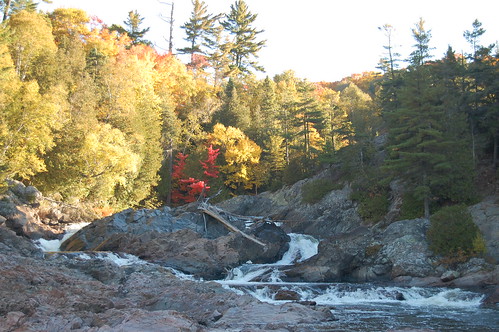
I have an affinity for rock. Rock emerging from the surface of the earth – insistent, unmitigated, regal. Stones, not so much. Where I grew up in south western Ontario, we liked to say that we had a hundred and fifty feet of topsoil. Each spring stones as big as cantaloupes would sprout in my grandfather’s cornfields. They would need to be “picked” before the spring ploughing could commence. Stones are an annoyance. A deathly annoyance for my grandfather. Rock, by contrast, is elemental.


Chippewa Falls

Chippewa Falls


Almost three hours drive from my childhood home, on the way to Toronto, there are protrusions from the Niagara escarpment that border the highway. Rock! How I used to relish seeing those nubs on our rare travels that way. Years later I saw plenty of rock in Sweden, and also Nepal, as well as the rolling Gatineau hills near Ottawa. But a recent first visit to northern Ontario has set a new benchmark for rock.


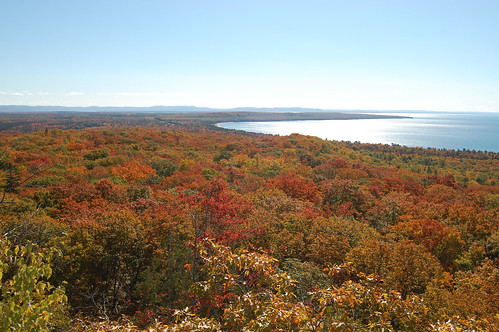
Pancake Bay

Pancake Bay


If you are planning a visit to northern Ontario, I recommend choosing the last weekend in September. If possible, arrange for brilliant clear blue skies during the day, and crisp cold nights with a full moon. Push the blustery autumn storms into late October or November so that the lurid palette brushed on to the oak and maple and birch leaves can work its wonder. Then take a drive northward from Sault Ste Marie towards Wawa on the Trans Canada highway. And just marvel.


Agawa Bay

Agawa Bay


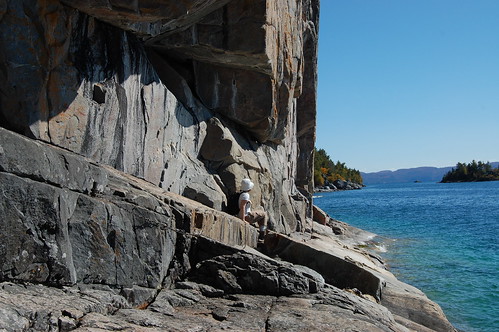
Oh, and be sure to keep an eye out for some serious rock.


Agawa Rock

Agawa Rock

Telegraph Avenue by Michael Chabon


Beyond the limits of nostalgia lies a strange land of wistfulness, dream, and fetish. This is the landscape that Michael Chabon charts in Telegraph Avenue whose nominal focus is Brokeland Records, a struggling used-record store on Oakland’s storied Telegraph Avenue. Brokeland is a natural focal point for nostalgia, as customers seek to revisit the music of their youth. But it is also the jumping off point for visitations to the land beyond nostalgia, as some customers seek out the false (?) nostalgia of times which were not their own. As, for example, when one customer, the hefty white whale-lawyer Michael “Moby” Oberstein, embarrassingly takes on the argot of the black hip-hop artists he admires. Or, when Julie Jaffe and Titus Joyner, both teenage boys, live their imaginative lives in films that were released when their fathers or even their grandfathers were young. This slip from nostalgia to false nostalgia to outright fetishism tokens a corresponding, and possibly worrying, disconnect with one’s own time and place.

Chabon’s writing here is never less than rich, at times moving up the colour palette to lurid, as when he takes on the stylistic excess of H.P. Lovecraft in order to dramatize young Julie’s imaginative life, or when he follows an exotically coloured, escaping parrot in one long paragraph over ten pages. This might be described as filmic writing, as Chabon moves from scene to scene, with long-shots and close-ups and jump-cuts. Initially it works against a close emotional connection with any one of the large cast of characters. But over the course of such a long novel that temporary distancing is more than compensated for by the emotional impact of culminating plot.

Fathers and sons, without doubt, are the pervasive motif in this novel, as well as the respect due to each. And although motherhood and certainly pregnancy are important both in terms of plot and language—the two main female characters share a midwifery practice—Chabon does not succeed in bringing them or their concerns fully to life. Perhaps there are some territories that remain yet unexplored by this absorbing writer.

Don’t be put off if the music and films referenced in the novel are only on the edge of your awareness. This is not, or at least it shouldn’t be, a contest in geeky knowledge. Indeed the suggestion is, iterated over and over again here, that it doesn’t matter whether you have direct experience of pop-cultural phenomena. Second or third-hand experience will more than suffice. Or even just a name dropped in the right place.

Plenty to think about and enjoy here. Highly recommended.